
-
Damascus Pattern Nakiri Cleaver Knife with Red Resin Handle
Regular price $145.00 USDRegular price

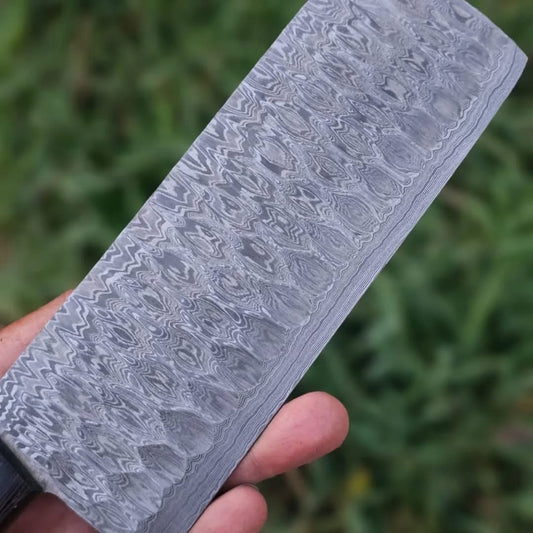
Handmade Nakiri Knife – Damascus Japanese Vegetable Knives
If you prep a lot of vegetables, the Nakiri will change the way you cook. This straight-edged Japanese vegetable knife is purpose-built to chop, slice, and dice produce in clean, full strokes. Our collection brings together hand-forged Damascus and high-carbon Nakiri knives that pair authentic blade geometry with striking handmade finishes.
What Is a Nakiri Knife Used For?
A Nakiri is a vegetable specialist. Its tall, flat, rectangular blade lets the entire edge meet the board in a single down-stroke, so you get complete cuts with no rocking and no “accordion” slices that stay joined at the bottom.
- Chopping and slicing all kinds of vegetables and fruit
- Producing fine, even juliennes and brunoise
- Quickly dicing onions, peppers, and root vegetables
- Shredding cabbage and leafy greens
Nakiri vs Santoku — What's the Difference?
Both are Japanese knives, but they specialise differently. A Nakiri has a flat, square-tipped blade made purely for vegetables and push-cutting, while a Santoku has a slight curve and tip that also handles meat and fish. If most of your prep is produce, the Nakiri is the sharper tool for the job.
Why Choose Our Hand-Forged Nakiri
- Flat, double-bevel edge for clean board-contact cuts every time
- Hand-forged Damascus and high-carbon steel with a razor-fine edge
- Tall blade face that doubles as a scoop for transferring ingredients
- Full-tang build with balanced, comfortable hardwood handles
- Eye-catching Damascus patterning unique to each knife
Frequently Asked Questions
Q: Is a Nakiri better than a chef's knife for vegetables?
For pure vegetable prep, many cooks prefer the Nakiri because its flat edge makes complete, even cuts without rocking. A chef's knife is more of an all-rounder.
Q: Can you cut meat with a Nakiri knife?
A Nakiri is designed for vegetables and isn't suited to bones or heavy meat tasks. For boneless slicing it can help, but a Santoku or chef's knife is the better all-purpose choice.
Q: Are Nakiri knives good for beginners?
Yes. The simple straight-down cutting motion is easy to learn and very safe, which makes the Nakiri a great first Japanese knife.
