
-
5-Piece Hammered Black Knife Set with Wood Handles and Leather Roll Case
Regular price $199.00 USDRegular price -
6-Piece Crimson Handle Japanese Chef Knife Set with Layered Handles
Regular price $269.00 USDRegular price -
Brown Pakkawood Full-Tang Kitchen Knife Set for Everyday Cooking
Regular price $349.00 USDRegular price -
Wingcrest Bone Wing Guard Damascus Santoku Knife Set for Multi Cook Kitchens
Regular price $299.00 USDRegular price -
Anvilgrey Serbian Chef Knife Set with Six Forged-Finish Blades
Regular price $299.00 USDRegular price -
Twin Stag Handle Chef Knife Set with Feather Pattern Blades for Gifting
Regular price $329.00 USDRegular price -
Olive Wood Handle Santoku Knife with Japanese Style for Precision Kitchen Prep
Regular price $198.00 USDRegular price -
Copper Wood Handle Nakiri Chef Knife with Black Bolster for Precise Vegetable Prep
Regular price $155.00 USDRegular price -
Red Black Handle Santoku Chef Knife with Brass Bolster for Controlled Cuts
Regular price $166.00 USDRegular price -
Blue Purple Resin Handle Kiritsuke Knife with Black Bolster for Precise Cutting
Regular price $179.00 USDRegular price -
Dark Horn Handle Chef Knife with Wide Cutting Blade and Leather Sheath
Regular price $178.00 USDRegular price -
7 Piece Emerald Damascus Western Chef's Set with Black Wood Handles
Regular price $299.00 USDRegular price -
Azure Tide Culinary Knife Set with Solid Azure Blue Handles
Regular price $200.00 USDRegular price -
Pakka Wood Handle Chef & Santoku Knife Set – 5 Pieces
Regular price $220.00 USDRegular price -
Crimson Vortex Chef Knife Set with 5 Forged Damascus Blades
Regular price $259.00 USDRegular price -
6-Piece Chef Knife Set with Sharpening Rod and Leather Roll Case
Regular price $289.00 USDRegular price -
6-Piece Blue Handle Chef Knife Set with Sharpening Rod
Regular price $255.00 USDRegular price -
5-Piece Pink and Blue Resin Handle Chef Knife Set with Patterned Steel Blades
Regular price $299.00 USDRegular price -
Damascus Orchid Chef Knife Set with Wood Grain Blades and Turquoise Inlay
Regular price $289.00 USDRegular price -
Culinary Craftsman Chef Set with Six Handcrafted Kitchen Knives
Regular price $290.00 USDRegular price


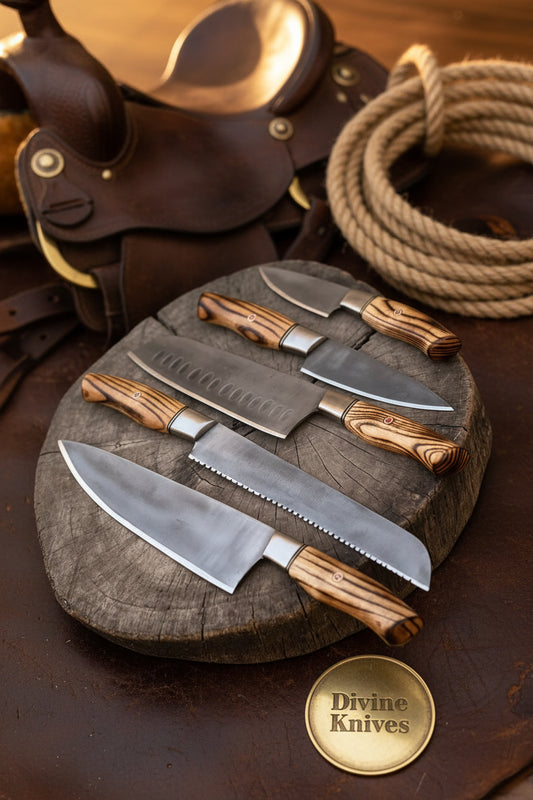


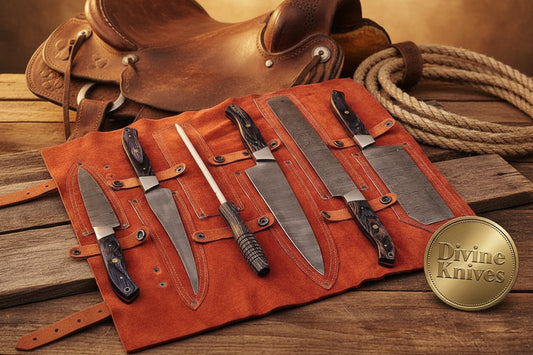

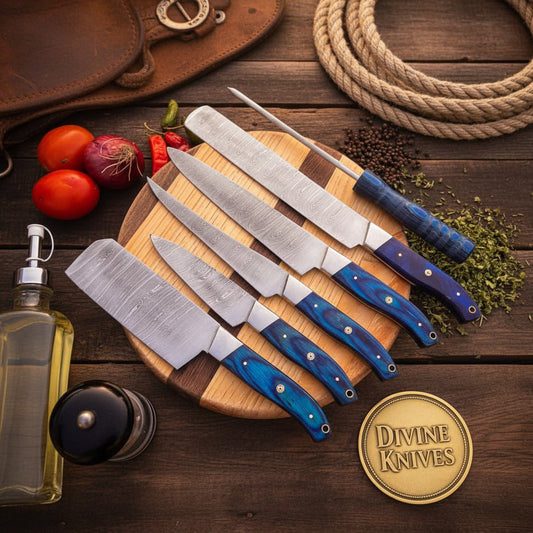


Handmade Santoku Knife – Damascus & High-Carbon Japanese Kitchen Knives
The Santoku is Japan's most-loved all-purpose kitchen knife. Its name translates to “three virtues” — slicing, dicing, and mincing — and that versatility is exactly why home cooks and professional chefs reach for it every day. Every Santoku in this collection is hand-forged by skilled artisans, blending authentic Japanese blade geometry with the beauty of Damascus and high-carbon steel.
What Is a Santoku Knife Used For?
A Santoku is built for precise, everyday food prep. The flat cutting edge and slight tip curve favour a clean push-cut rather than the rocking motion of a Western chef's knife, giving you faster, more uniform slices.
- Thinly slicing vegetables, fruit, and boneless meat
- Dicing onions, herbs, and aromatics with control
- Mincing garlic, ginger, and chillies
- Creating clean, paper-thin cuts of fish for sashimi-style prep
Why Choose a Hand-Forged Damascus Santoku?
- Hand-forged Damascus and high-carbon steel for a long-lasting, razor-keen edge
- Granton (hollow-ground) dimples that release food and stop slices sticking to the blade
- Balanced 5 to 7 inch blade length that feels nimble in any hand
- Full-tang construction with triple-riveted hardwood handles for control and durability
- Distinctive flowing Damascus pattern — no two knives are identical
Santoku Knife vs Chef's Knife — Which Should You Pick?
Both are all-rounders, but they cut differently. A Santoku has a flatter edge and lighter tip suited to straight up-and-down chopping and fine slicing, while a chef's knife has a curved belly made for rocking. Cooks who prefer precise, controlled cuts and a lighter knife in hand tend to favour the Santoku.
Frequently Asked Questions
Q: What size Santoku knife is best?
A 5-inch Santoku is ideal for nimble tasks and smaller hands, while a 7-inch blade gives more reach for larger vegetables and proteins. Most home cooks find the 7-inch a comfortable everyday size.
Q: Is a Santoku knife good for beginners?
Yes. Its lightweight balance and simple push-cut motion make it one of the easiest knives to learn with, and the flat edge encourages safe, controlled slicing.
Q: How do I keep a high-carbon Santoku from rusting?
Hand-wash and dry it straight after use, avoid the dishwasher, and wipe the blade with a little food-safe mineral oil before storing. This keeps both Damascus and high-carbon edges in top condition.
