
-
Curved Kukri Knife with Companion Blade and Sheath
Regular price $288.00 USDRegular price -
Bone Handle Bowie Dagger with Brass Guard and Sheath
Regular price $233.00 USDRegular price -
Serrated Spine Skinner Knife with Natural Bone Handle
Regular price $211.00 USDRegular price -
Brut de Forge Drop Point Hunting Knife with Bone Handle for Field Dressing
Regular price $150.00 USDRegular price -
Damascus Crown Stag Sub-Hilt Bowie with Brass Double Guard for Camping
Regular price $180.00 USDRegular price -
Quillspine Burl Wood Feather-Shaped Damascus Dagger with Carved Red Burl Handle
Regular price $199.00 USDRegular price -
Bone Stacked Blood Groove Clip Point Bowie with Polished Blade
Regular price $180.00 USDRegular price -
Polished Steel Sub-Hilt Bowie Knife with Mirror Finish for Hunting and Display
Regular price $180.00 USDRegular price -
Mammoth Ivory Sub-Hilt Bowie with Contoured Ivory Handle
Regular price $170.00 USDRegular price -
Segmented Bone Damascus Boot Dagger with Segmented Bone and Wood Handle
Regular price $199.00 USDRegular price -
Bone Handle Sawback Hunting Knife with Notched Spine and Camo Spacer Inlays
Regular price $244.00 USDRegular price -
Hooktip Staghorn Damascus Gut Hook Skinner with Carved Finger Grooves
Regular price $160.00 USDRegular price -
Buffalo & Ramhorn Gut Hook Knife Set with Natural Horn Handles
Regular price $180.00 USDRegular price -
Wildbark Antler Damascus Gut Hook Skinner with Natural Bark Scales
Regular price $150.00 USDRegular price -
Stacked Antler Damascus Drop Point Knife with Colored Spacers and Brass Fittings
Regular price $150.00 USDRegular price -
Crown Stag & Resin Handle Bowie Knife with Hybrid Natural Grip
Regular price $150.00 USDRegular price -
Trailhide Damascus Antler Frontier Bowie with Full Antler Handle
Regular price $160.00 USDRegular price -
Eagle Talon Gut Hook Knife with Bird Cutout Blade and Antler Handle
Regular price $180.00 USDRegular price -
Crown Stag Antler Bowie Knife with Large Mirror Clip Point Blade and Leather Sheath
Regular price $244.00 USDRegular price -
Stag Antler Cowboy Bowie Knife with Brass Guard and Tooled Leather Belt Sheath
Regular price $211.00 USDRegular price


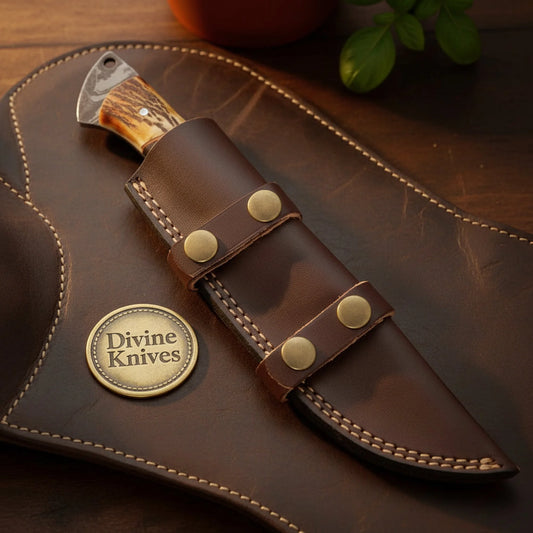


A stag handle knife pairs a steel blade with a grip made from deer antler, a natural material prized for its rugged texture and warm color. This collection brings together fixed blades with stag handles, from bushcraft and belt knives to hunting and Bowie styles, many with Damascus blades and leather sheaths. Because every handle comes from real antler, no two knives look exactly alike. Each listing shows the blade length, steel, handle details, and sheath.
What Is a Stag Handle Knife?
A stag handle knife, sometimes called a stag-handled knife, has a handle cut from the antler of a deer. Knife makers have used stag for generations because it combines a naturally grippy surface with a look that's different on every piece. The outer bark of the antler is ridged and textured, while cut or polished areas show smoother, lighter material underneath.
Stag Antler vs. Stag Horn: Clearing Up the Name
You'll see both "stag antler handle knife" and "stag horn handle knife" used for the same thing. Strictly speaking, deer grow antlers, not horns:
- An antler is bone. Deer grow a new set every year and shed the old one. Stag antlers come from antlers.
- A horn is a sheath of keratin over a bony core, and it isn't shed. Ram, buffalo, and cattle horns are true horns and look and feel different from stag.
"Staghorn" is a long-established trade name, so it's correct to use, but if you specifically want antler rather than ram or buffalo horn, check the handle material on the listing.
Crown Stag, Scales, and Full Sections
Stag can be fitted to a knife in a few ways:
- Scales: Flat slabs of antler pinned to each side of a full tang, often with brass or steel pins.
- Full section: A whole piece of antler drilled to slide over a narrower tang, keeping its natural round shape.
- Crown stag: A section cut from the base of the antler, where it joined the skull. The knobby crown often forms the pommel and is especially sought after.
Why Choose a Stag Handle Fixed Blade Knife?
A stag handle fixed blade knife has a few practical and visual advantages:
- Natural grip: The ridged surface gives your hand something to hold, even when it's cold or wet.
- Individual character: Color, texture, and shape vary from piece to piece.
- Traditional look: Stag suits classic patterns such as hunters, bowies, and belt knives.
It also comes with trade-offs worth knowing:
- It's a natural material. Stag can crack if it dries out or gets hit hard, and it isn't as uniform as micarta or G10.
- Shapes vary. Two knives of the same model can feel slightly different in the hand.
- It needs a little care, mostly to keep it from drying out (see below).
Genuine Stag vs. Imitation Stag
|
Material |
What it is |
How to recognize it |
|
Genuine stag |
Real deer antler |
Irregular texture and color, a lighter porous core at cut ends, and no repeating pattern |
|
Jigged bone |
Cattle bone carved and dyed to imitate stag |
Even, repeated carving marks with smooth areas between them |
|
Synthetic stag |
Resin molded to look like antler |
Uniform pattern, sometimes visible mold lines, and often lighter in weight |
Our listings state the handle material, such as "natural stag horn" or "genuine stag antler," so you know what you're buying.
Compare Featured Stag-Handled Knives
|
Knife |
Blade / overall |
Blade |
Handle |
Sheath |
A good fit for |
|
Staghorn Damascus Upswept Bushcraft Knife |
4.5 in / 9 in |
Wood-grain Damascus, upswept with heel notch, full tang |
Natural stag horn, brass pins |
Dark leather with floral tooling and belt loop |
Skinning, bushcraft and detail work |
|
Rasp Steel Antler Cowboy Belt Knife |
4 in / 8.5 in |
Rasp-style hand-ground steel, full tang |
Genuine stag antler, lanyard hole, no bolster |
Honeycomb tooled leather belt sheath |
Everyday ranch and camp carry |
Also in the collection are the Eagle Head Gut Hook Knife with a natural stag antler handle and cast brass pommel, and stag-handled bowies such as the Stag Antler Classic Bowie. Check each listing for exact dimensions.
How to Choose a Stag Handle Fixed Blade Knife
Match the Blade to the Job
For field dressing and skinning, look at compact blades of around 3 to 5 inches. Our stag handle hunting knives gather those styles together. For camp chores and bushcraft, an upswept or drop point blade around 4 to 5 inches covers most tasks. For a larger, traditional statement piece, browse our stag handle bowies.
Look at How the Stag Is Attached
Pinned stag scales on a full tang are the sturdiest choice for hard use, because the steel runs through the handle. Full-section and crown stag handles show off more of the antler's natural shape and are popular with collectors.
Check the Sheath
A good leather sheath protects both the blade and the stag from knocks. Tooled leather adds to the traditional look. Each listing states what sheath comes with the knife.
Handmade and Custom Stag Handle Knives
Every handmade stag handle knife in this collection is fitted individually, because no two pieces of antler are the same size or shape. The maker shapes the handle around the natural curves of the antler, which is why each knife has its own character.
If you're looking for a custom stag handle knife built to your own design, that isn't a standard service at Divine Knives. When a product can be customized, the option appears on its product page. For other questions about a specific knife, contact us before ordering.
Caring for a Stag Handle
Stag is durable but needs a little attention to stay in good condition:
- Keep it dry. Wipe the handle after use, and never soak the knife or put it in a dishwasher.
- Avoid heat and direct sun. Leaving stag in a hot car or a sunny window can dry it out and cause cracks.
- Feed it occasionally. A thin coat of mineral oil or a neutral wax every few months keeps antler from drying out.
- Protect it from knocks. Store the knife in its sheath, and avoid using the handle as a hammer.
- Oil the blade too. High-carbon and Damascus blades need a light coat of oil to prevent rust.
- Don't store it damp. If the sheath gets wet, let both the knife and sheath dry fully before putting them away.
Why Buy Stag Handle Knives From Divine Knives
Our stag handle knives for sale combine natural antler with blades in Damascus, high-carbon, and rasp-style steel, and come with leather sheaths where listed. Every product page names the handle material and gives the blade and overall length, so if you're comparing a stag handle knife for sale elsewhere, you can see exactly what you're getting with ours. For folding options, see our stag handle folding knives.
Unused knives in their original packaging can be returned within 30 days; see our refund policy. We ship to the USA and internationally, with tracking emailed as soon as your order leaves our workshop.
Frequently Asked Questions
What is a stag handle on a knife?
It's a handle made from deer antler. The surface is naturally ridged and textured, and color and shape vary from piece to piece.
Is stag horn the same as antler?
Yes. "Stag horn" and "staghorn" are traditional names for deer antler. True horn, such as ram or buffalo horn, is a different material.
How can I tell if a stag handle is real?
Real stag has irregular texture and color, a lighter porous core at cut ends, and no repeating pattern. Jigged bone and synthetic stag look more uniform.
Will a stag handle crack?
It can if it dries out or takes a hard knock. Keeping it away from heat and applying a little oil or wax now and then helps prevent cracks.
Is a stag handle good for hunting?
Yes. Its ridged surface gives a secure grip, even with cold or wet hands. Wipe it clean and dry after field use.
Can I put a stag handle knife in the dishwasher?
No. Heat and long exposure to water can dry out and crack the antler and rust the blade. Hand wash and dry it right away.
What is crown stag?
It's a section cut from the base of the antler. The knobby crown often forms the pommel of the knife and is popular with collectors.
