Divine Knives
Longship Norse Engraved Viking Axe with Bearded Head and Inlaid Rosewood Haft
Longship Norse Engraved Viking Axe with Bearded Head and Inlaid Rosewood Haft
Couldn't load pickup availability
The Norse-engraved Viking Axe hangs a beard below the eye. That lower hook is the whole point of the shape. It stretches the cutting edge without adding head weight. Norse smiths worked out that trade centuries ago. Grip behind the beard, and the axe becomes a carving tool.
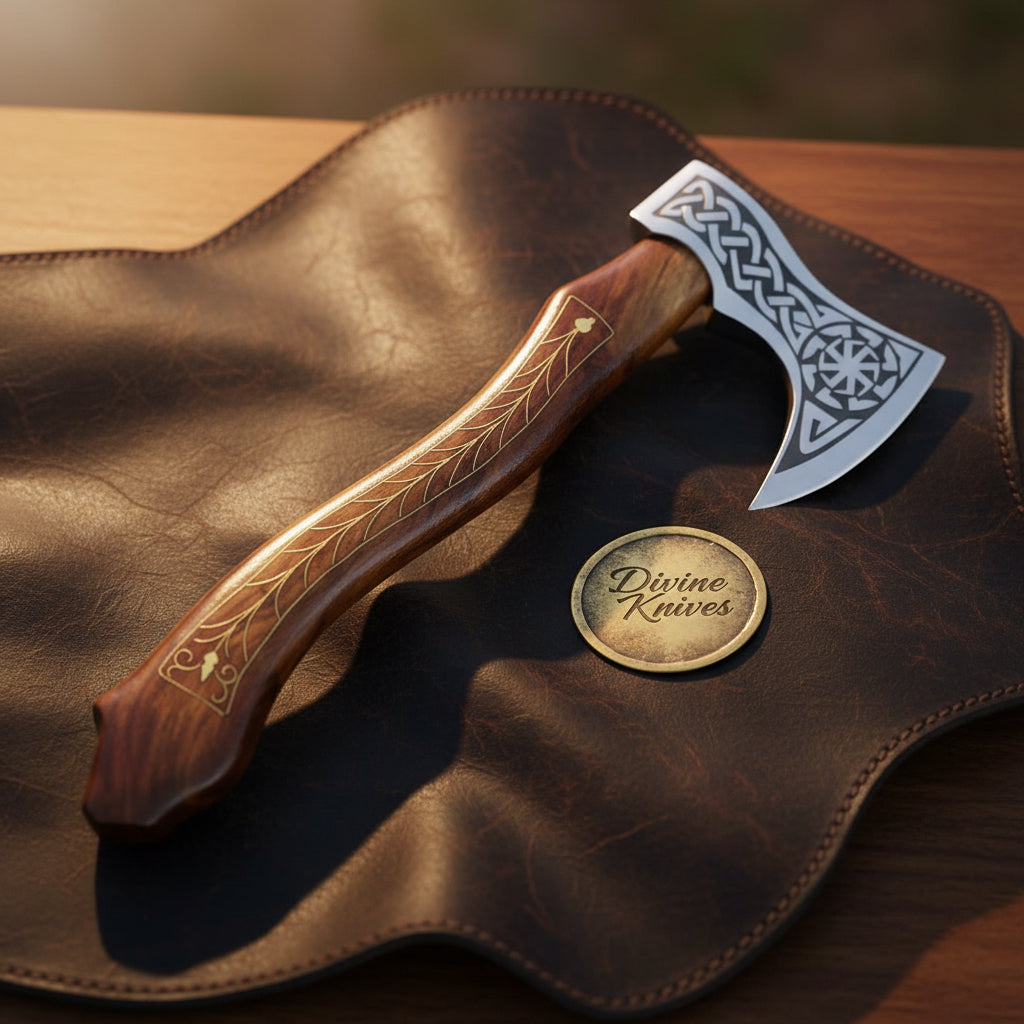
The head is polished steel, not layered Damascus. Artwork comes from etching into the surface rather than from folded metal. Knotwork bands run the top edge in an unbroken weave. A spoked wheel motif fills the center of the cheek.
This engraved Viking axe for sale carries artwork on both cheeks. Braided inlay traces the full length of the rosewood haft.
Engraved Viking Axe at Divine Knives with a bearded head, etched knotwork on both cheeks, a spoked wheel motif, and braided inlay running the full rosewood haft.
The History Behind This Engraved Norse Axe
Bearded axes turn up across Viking Age graves in Norway and Sweden. Norse smiths built them between the eighth and eleventh centuries. Most households owned an axe long before anyone owned a sword. Knotwork styles like Borre and Urnes decorated tools and stonework alike. Divine Knives etches those traditions onto a modern polished head.
Norse Engraved Viking Axe Performance
The beard gives you two hand positions. Choke up behind it for close carving and shaping. Drop back to the haft end for full swing reach. Bearded heads were built for exactly that range.
Balance sits forward, just ahead of your front hand. A 4-inch edge bites without the mass of a felling axe. The polished steel keeps the etching crisp against a bright ground. Handle it with dry hands and the finish stays clean. Wipe the head down after any display handling.
Viking Axe Design and Construction
Rosewood forms the haft in one continuous piece. Deep red-brown with darker grain running the length. The profile curves through a gentle S and flares at the butt. That flare stops your hand from sliding off the end.
A braided vine line weaves down the center of the haft. The light inlay reads clearly against dark rosewood. Decorative motifs cap each end of the run. The head seats on the haft through a shaped eye. Keep the rosewood oiled and store the axe away from damp.
Best Uses for the Longship Axe
This axe belongs on a wall mount or a display stand. The etching reads best with light coming from one side. Collectors buy Norse Viking axe pieces for the artwork above all. Reenactors and Norse history enthusiasts are the other main buyers. It gifts well to anyone drawn to Scandinavian craft.
Order the Longship Norse Engraved Viking Axe today. Etched knotwork and full-length haft inlay rarely appear on one piece.
Specifications
- Product Type: Single Norse-style bearded axe
- Head Material: Polished carbon steel
- Head Finish: High polish with dark etched detail
- Head Style: Bearded, hooked lower blade below the eye
- Engraving: Interlaced knotwork top band, spoked wheel cheek motif, knotwork border above the beard
- Overall Length: 16 inches
- Cutting Edge Length: 4 inches
- Head Depth, Eye to Edge: 5 inches
- Head Height, Top to Beard Tip: 6 inches
- Haft Material: Rosewood, single continuous piece
- Haft Profile: Gentle S-curve with a flared butt
- Haft Inlay: Braided vine line running full length, with capped end motifs
- Mounting: Shaped eye seat
- Edge: Hand sharpened on arrival
FAQ’s
What is a bearded axe?
A bearded axe drops a hook of steel below the eye. That beard extends the cutting edge without adding head weight.
Is this axe head Damascus steel?
No. The head is polished carbon steel with artwork etched into the surface. The pattern is decorative rather than forged in layers.
What do the engravings show?
Interlaced Norse knotwork runs the top band. A spoked wheel motif fills the cheek. Both are drawn from Viking Age ornament.
Can you grip the axe behind the beard?
Yes. Choking up behind the beard shortens your reach for close carving work.
How is this different from the Quillspine dagger?
The Quillspine is a forged feather Damascus blade with a burl handle. This axe uses plain polished steel with etched Norse artwork.
What is the haft made from?
The haft is rosewood, cut in one piece with a braided inlay line. It curves through the length and flares at the butt.