Divine Knives
Featherfall Norse Viking Raven Bearded Axe with Feather Carved Haft
Featherfall Norse Viking Raven Bearded Axe with Feather Carved Haft
Couldn't load pickup availability
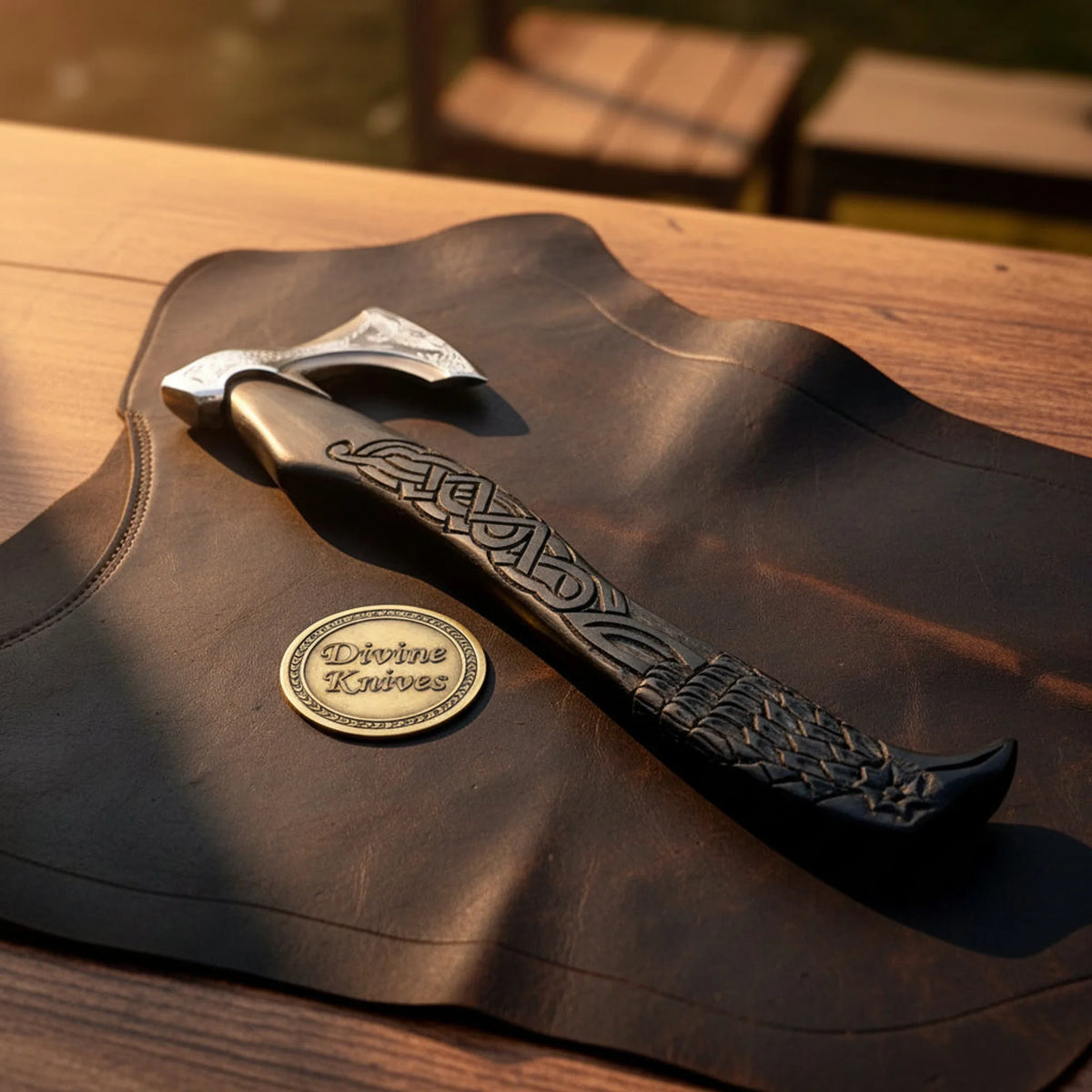
The Norse Viking Raven Bearded Axe changes carving language halfway down. Flowing interlace fills the upper haft in ribbon work. Below that, the surface breaks into overlapping feathers. Two different disciplines meet on one piece of wood. Most carved hafts pick one and repeat it. Switching partway takes two sets of tools.
The head sits small against all that. Etching covers its face, but the haft holds the attention. A beard hooks down with an open gap behind it. This raven axe for sale runs 15 inches overall. The carving runs almost the full haft length.
Viking Axe collection at Divine Knives with interlace carved above a feather field, a dark relief haft running nearly full length, and a small etched bearded head.
The History Behind This Raven Motif Axe
Ravens appear across Norse metalwork more than almost any creature. Smiths worked them into brooches, pendants, and helmet plates alike. Beaks and eyes were reduced to a few curved lines. Feather fields then filled the space behind them in rows. Divine Knives carves both of those elements into one haft.
Norse Viking Raven Bearded Axe Performance
Carved relief does the grip work here. Raised interlace and feather ridges catch a palm directly. Nothing wraps over the wood, and nothing needs replacing. Bare carving grips better dry than leather does when wet. Ridges sit exactly under the palm.
A small head keeps weight close to your hand. That makes fifteen inches feel shorter than it measures. Accuracy holds through repeated strikes. Three inches of edge suits kindling and light shaping. Wipe the head and leave the carving alone.
Specifications
- Product Type: Single bearded axe with a carved haft
- Head Material: Steel
- Head Pattern: Plain steel with etched face
- Head Finish: Bright polished with etching
- Head Style: Bearded with an open gap, small relative to the haft
- Overall Length: 15 inches
- Cutting Edge Length: 3 inches
- Head Height: 4 inches
- Head Depth, Poll to Edge: 4.5 inches
- Haft Material: Dark blackened wood
- Haft Decoration: Relief carving nearly full length, interlace on the upper two-thirds, overlapping feather field on the lower section
- Butt: Flared with further carved detail
- Edge: Ground and honed
Carved Haft Axe Design and Construction
Relief carving cuts into the haft rather than onto it. Wood was removed around every raised line. Interlace takes the upper two-thirds of the length. Overlapping feathers fill the lower section in rows. Each row sits slightly proud of the last.
A flare closes the butt with more carved detail. The haft runs dark from the head to that flare. Nothing is wrapped, inlaid, or studded anywhere on it. The head seats through an eye above the carving. Dust settles in relief, so brush it out occasionally.
Best Uses for the Featherfall Axe
The carving only reads properly in your hand. A stand shows it better than a flat wall mount. Norse collectors buy Norse raven axe pieces for the haft carving. Reenactment kits take a steady share of them. Camp work still fits at fifteen inches. Buy a raven Viking axe today. Two carving styles on one haft is an uncommon build.
FAQ’s
Why does the carving change partway down?
Interlace fills the upper haft and feathers fill the lower. Two vocabularies rather than one repeated.
Is the raven shown as a whole bird?
Feather texture and interlace suggest it rather than draw it outright. Norse carvers worked that way.
Is the carving cut in or applied on top?
Cut in. Wood was removed around every raised line.
How is this different from the Deepbeard Skeggox?
The Deepbeard has a deep beard, jute twine, and a head cover. This has a smaller head, feather carving, and no wrap.
Why is the head so small?
A light head keeps weight near your hand. It trades splitting power for control.