Divine Knives
Vegvisir Viking Norse Compass Axe with Cut Stave and Knotwork Head
Vegvisir Viking Norse Compass Axe with Cut Stave and Knotwork Head
Couldn't load pickup availability
The Vegvisir Viking Norse Compass Axe carries a symbol younger than its name suggests. The eight staves first appear in an Icelandic manuscript from 1860. That puts them roughly eight centuries after the Viking Age ended. Most listings never mention it. The stave is still Icelandic and still a wayfinding mark.
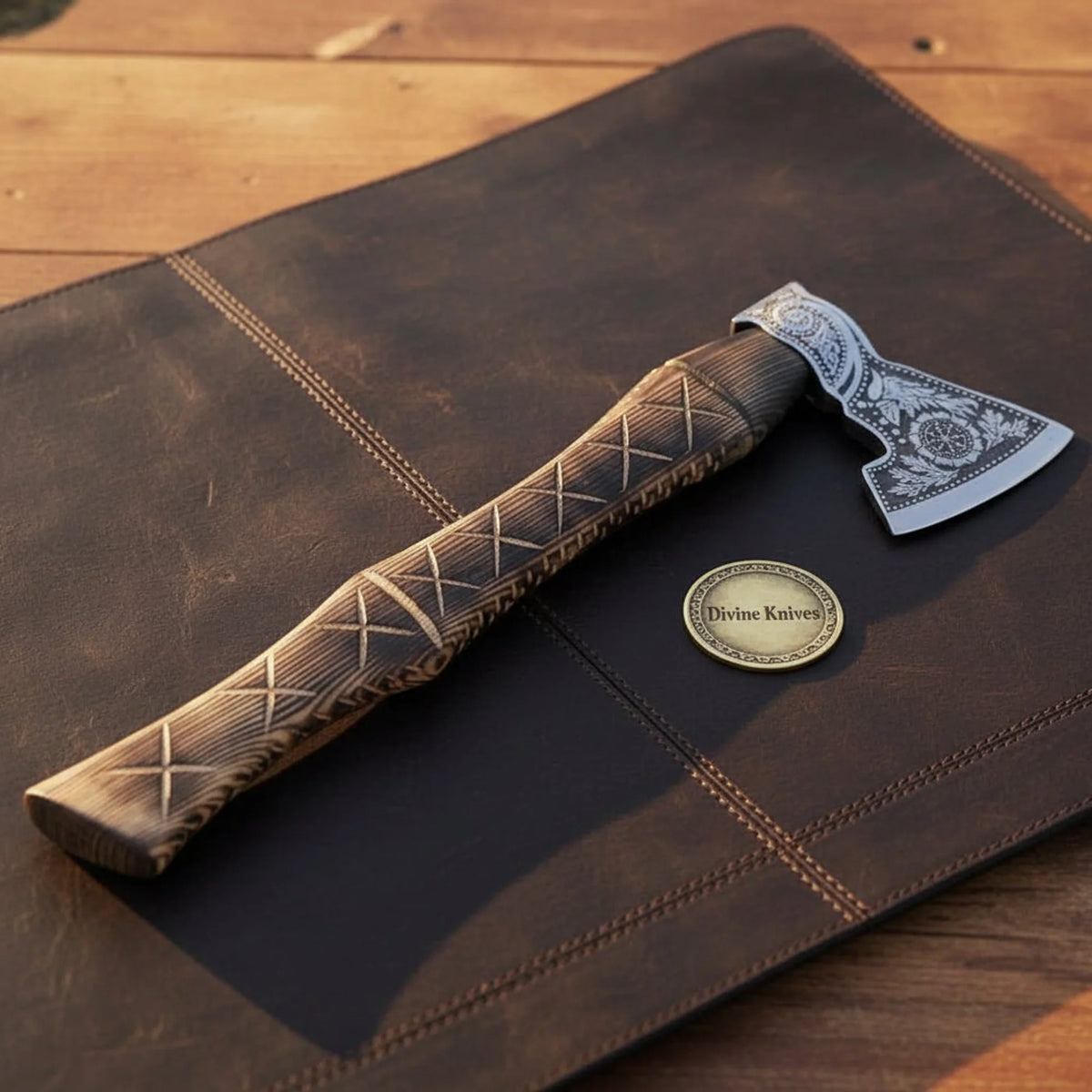
The engraving covers the whole head face. Knotwork frames the edges and the beard. The compass sits at the center of the cheek. Every line is cut into the steel.
This Viking Norse axe for sale runs 16 inches overall. Fire-darkened wood makes up the haft, with carved crosses down it.
Norse Compass Axe at Divine Knives with a compass stave cut into the cheek, knotwork framing every edge, and a fire-darkened haft carved with crosses.
The History Behind This Vegvisir-style Compass Axe
The Vegvisir comes from Icelandic magical staves rather than Norse carving. It appears in the Huld Manuscript, compiled in Iceland in 1860. Similar staves fill several Icelandic grimoires from the same century. Folk tradition held the mark guided a traveler through bad weather. Divine Knives cuts it beside older knotwork on one head.
Vegvisir Viking Norse Compass Axe Performance
Engraving stops short of the working bevel. That leaves the cutting edge free to be sharpened forever. Deep etching near an edge would open a weak line. This one keeps the artwork above the grind.
Fire-darkened wood grips harder than a sanded surface. The char leaves a fine tooth across the whole haft. Carved crosses add a second texture over the top. Four inches of edge handles kindling and shaping. Sixteen inches keeps it swinging without needing two hands.
Specifications
- Product Type: Single engraved bearded axe
- Head Material: Carbon steel
- Head Finish: Light polished ground with dark etched detail
- Head Style: Bearded with an open gap and a stepped upper horn
- Engraving: Knotwork bands at the top and above the beard, eight-armed compass stave central, vine and leaf infill
- Overall Length: 16 inches
- Cutting Edge Length: 4 inches
- Head Height: 5 inches
- Head Depth, Poll to Edge: 5.5 inches
- Haft Material: Torched wood, cream through near black
- Haft Decoration: Carved X crosses cut through the fired surface, plus angular geometric bands
- Leather: None
- Haft Profile: Near straight with a slight swell, flared butt
- Mounting: Eye seat above the carved run
- Edge: Ground and honed
Norse Compass Axe Design and Construction
The head fills every available surface with cut line work. Knotwork bands run the top edge and above the beard. A circular stave with eight arms sits centrally on the cheek. Vine and leaf forms fill the space around it.
Fire took the haft before any carving happened. Pale wood turned cream and near black in bands. Crosses were then cut through the darkened surface. The butt end sits darkest of all. The head seats through an eye above the carved run. Sealed char needs less oil than bare wood does.
Best Uses for the Wayfinder Axe
The stave is what sells this one, not the edge. A stand or a wall mount shows the cheek best. Collectors buy Vegvisir compass axe pieces for the stave alone. Icelandic and Norse interest groups make up the core market. It still splits kindling if you want it to.
Order the Wayfinder Axe today. Very few axes pair a cut stave with a fire-darkened haft.
FAQ’s
What does the Vegvisir symbol mean?
Icelandic folk tradition treated it as a wayfinding mark. The idea was to help a traveler hold course in bad weather.
Is the Vegvisir a genuine Viking symbol?
No. It first appears in an Icelandic manuscript from 1860. That is roughly eight centuries after the Viking Age.
How is this different from the Longship engraved axe?
The Longship pairs knotwork with an inlaid rosewood haft. This pairs a compass stave with a fire-darkened carved haft.
Will sharpening damage the engraving?
No. The cut work stops well above the bevel and never meets the stone.
What are the crosses on the handle?
Carved marks cut through the darkened surface after the wood was fired. They add texture under the palm.